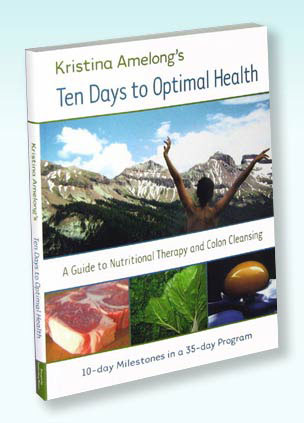





15% OFFKristina Amelong's Ten Days to Optimal Health MORE INFO |
Since I've Started Practicing The Enemas, I've Come A Long Way Since I’ve started practicing the enemas, I've come a long way. The experience is something that you can't describe in words but has to be tried. With each attempt I learned more about my body. First it was a realization of where the water was traveling in my system. Then the awareness of how to work through and diminish cramping... |
Intriguing Website I am very impressed by your intriguing website on a subject as controversial as the enema... |
|
|
 |
 |
|
|
 |
Metabolic Type Testing in Madison, WI or By Phone/Online
Core Premises of Metabolic Typing
How Does Metabolic Typing Work?
The Metabolic Typing Diet by William Wolcott and Trish Fahey
How Does Heredity Affect My Diet?
Your dietary needs are largely determined by heredity. Over thousands of years of evolutionary history, people in different parts of the world developed very distinct nutritional needs in response to a range of variables — including climate, geography, and whatever plant and animal life their environments had to offer.
As a result, people today have widely varying nutrient requirements, especially with regard to macronutrients — the proteins, carbohydrates, and fats which are the fundamental dietary "building blocks," or the compounds most essential to sustaining life.
For example, many people who currently inhabit tropical or equatorial regions have a strong hereditary need for diets high in carbohydrates such as vegetables, fruits, grains, and legumes. These foods tend to provide the kind of body fuel that is most compatible with the unique body chemistry of people who are genetically programmed to lead active lifestyles in warm and humid regions of the world. Their systems are simply not designed to process or utilize large quantities of animal protein and fat.
Conversely, people from cold, harsh northern climates are not genetically equipped to survive on light vegetarian food. They tend to burn body fuel quickly, so they need heavier foods to sustain themselves. Eskimos, for example, can easily digest and assimilate large quantities of protein and fat — the very types of foods which would overwhelm the digestive tracts of people from, say, the Mediterranean basin.
The bottom line is that a diet considered "healthy" in one part of the world is frequently disastrous for people elsewhere in the world. For instance, well-known dietary expert Nathan Pritikin pointed out that Bantu tribes in Africa eat very low-fat diets, an approach that has long been widely regarded as very healthy in the U.S. and other industrialized societies. Not surprisingly, coronary artery disease and other modern degenerative diseases are almost non-existent among the Bantu.
Pritikin's successors and other leading health professionals have long advocated low-fat diets for everyone. Yet this one-size-fits-all approach has clearly failed to reduce obesity and cardiovascular disease for large segments of our population. Like all other universal dietary recommendations, it overlooks the enormous amount of biochemical and physiological diversity among individuals.
As an example, Scottish, Welsh, Celtic, and Irish people have certain nutritional requirements which are just the opposite of the African Bantu. The ancestral diets of the Scots and Irish and related cultures have always been very high in fatty fish.
For this and other reasons they have a hereditary need for more fat than other populations. So the low-fat diets that prevent heart disease in the Bantu can actually cause heart disease in some people of Anglo-Saxon descent.
This principle of diet being linked to genetic requirements is seen throughout nature. Every animal species is genetically programmed to feed on specific sources of food. Unlike man, who applies free will to his dietary choices, animals eat according to their natural instincts and genetic dictates. Consequently, insects, reptiles, fish, birds, and mammals (except man) are not plagued with degenerative health disorders like cancer, heart disease, diabetes, arthritis, allergies, and multiple sclerosis — to name but a few.
In his book, Happiness is a Healthy Life, Lendon Smith, M.D. writes, "The trick of eating is to figure out your racial / ethnic background and try to imitate it." It's a great idea, but there's just one problem — in today's day and age, few of us a have a clear-cut ethnic or genetic heritage. In places like the United States in particular, we've become a true genetic melting pot.
People from different ethnic and cultural backgrounds have moved from continent to continent and country to country and mixed and mingled like crazy. So most of us have a lot of different blood lines running through our veins.
Maybe you're part Irish and part German with traces of Mexican blood. Your best friend might be half Italian and half Japanese. Perhaps your neighbor has a Swedish mother and a Lebanese father and a maternal grandmother that was part Jamaican. The permutations are endless. There have been so many cultural shifts and so much intermarriage in the modern world that it's just not possible for most of us to identify — with a significant degree of precision — what our ancestral diet might be.
But here's a major caveat — while your ancestral diet is of critical importance in figuring out what foods might be ideal for you, it's not the only factor. Our nutrient requirements are also heavily influenced by our environments and the kinds of lifestyles we lead. But both have shifted dramatically over the course of the last century.
It took all of us thousands of years to adapt to our earthly surroundings, yet in the last 100 years — the evolutionary blink of an eye — many of the essential qualities of our air and water and soil have been altered, suddenly and profoundly. The delicate symbiosis that our ancestors developed with their natural habitats has been seriously disrupted. In many ways the environment can't sustain human health as it once could.
The same applies to our lifestyles. We've all been genetically bred over the millennia for a great deal of physical activity — to run and walk and plant and hunt and fish and ride and herd. But in a very short span of time that all changed. Now we spend huge blocks of time indoors under artificial light, exposed to all kinds of foreign chemicals, leading sedentary lives in front of TVs or computers or riding around in planes, trains, and automobiles.
So, identifying the diet that will best support your health is considerably more complicated than simply trying to determine your ethnic and cultural heritage. There are just too many different factors besides heredity which influence your nutritional needs.
Furthermore, your nutritional needs are not static. Your body is a dynamic homeostatic system — meaning it's always in flux, always attempting to regulate itself, achieve a healthy balance, and adjust to shifting environmental conditions.
Your dietary needs can change from year to year, season to season, day to day — even hour by hour, due to cyclical (circadian) rhythms which cause predictable shifts in your body chemistry every 24 hours.
The Optimal Health Center offers a breakthrough technology which you can use to quickly and easily identify which foods are right for you. It's called Metabolic Typing.

How Does Metabolic Typing Work?
The Metabolic Typing Diet by William Wolcott and Trish Fahey
Metabolic Type Testing in Madison, WI or By Phone/Online
Core Premises of Metabolic Typing
|
|
|
|
 |
 |
 | *NOTE: Any statements contained within on this website are for informational purposes only and have not been evaluated by the FDA. These products are not intended to diagnose, treat, cure, or prevent any disease. If pregnant or lactating, consult your physician before taking any products or using any procedure. |  |
|
 |
|
|
|
|